Loading...

Step-by-Step Procedure Guide
What to Expect During a Hair Transplant
Everything a Canadian needs to know about getting a hair transplant in Turkey — from your first consultation to your final results.
What Your Day Looks Like
Procedure Day
Just 6 to 8 hours to a new head of hair
One comfortable day. Watch Netflix, nap, relax — and walk out with thousands of new grafts already growing.
8:00am
Arrive & Prep
Check in, blood tests & hairline design
9:00am
Anesthesia
Quick local numbing
9:30am
Extraction
Grafts harvested while you watch a movie or nap
12:00pm
Lunch Break
Full meal — stretch your legs & recharge
1:00pm
Implanting
Thousands of grafts placed at the perfect angle
4:00pm
All Done!
Aftercare kit in hand — head to your hotel
Your Complete Walkthrough
Step by Step Guide
Step 1
Before You Begin
Understanding Your Hair Loss
Male pattern baldness (androgenetic alopecia) affects almost 50% of men by age 50. In Canada alone, millions of men experience noticeable hair thinning or recession by their 30s. It's caused by a combination of genetics and the hormone DHT (dihydrotestosterone), which gradually shrinks hair follicles until they stop producing visible hair.
The good news: the hair follicles at the back and sides of your head are genetically resistant to DHT. This is the "donor area" — and it's the key to a successful hair transplant. When these follicles are moved to thinning areas, they continue to grow permanently.
Many Canadian men explore options like minoxidil (Rogaine) or finasteride (Propecia) first, which can slow hair loss but rarely restore what's already gone. A hair transplant is the only permanent solution that moves your own living hair follicles to where they're needed most.
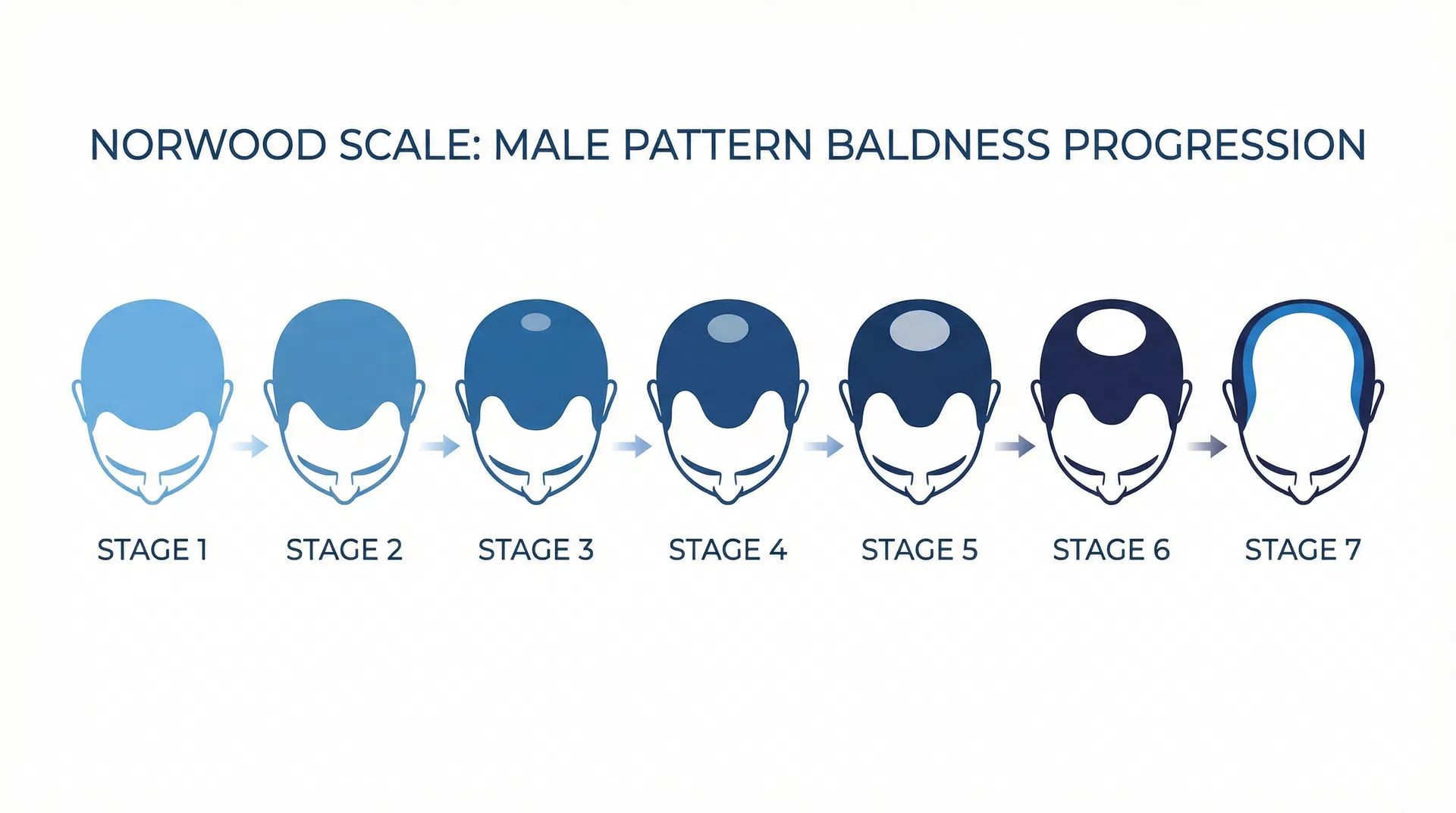
The Norwood Scale: most Canadian patients travelling to Turkey are between stages 3-5
Step 2
Planning Your Procedure
The Consultation & Hairline Design
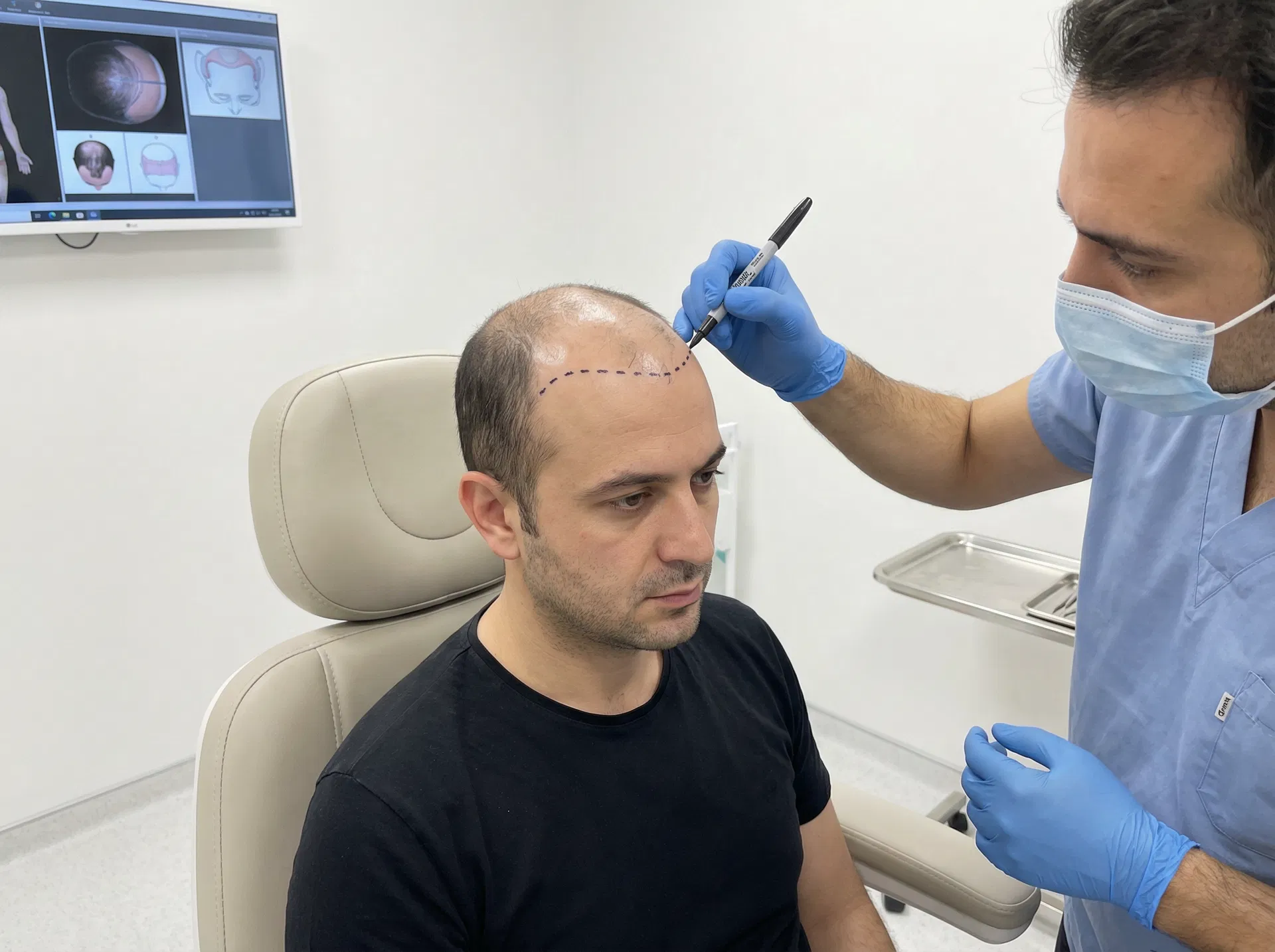
The surgeon carefully designs your new hairline — you approve before anything begins
Before any procedure, you'll have a thorough consultation — either in person at the clinic or via video call from the comfort of your home in Canada. Most reputable Turkish clinics offer these initial consultations completely free of charge. You can typically send photos via WhatsApp or email and receive a personalised assessment within 24 to 48 hours.
The hairline design is arguably the most important step. A skilled surgeon considers your facial proportions, age, ethnicity, and natural hair growth patterns to create a hairline that looks completely natural — not the "pluggy" look of outdated techniques. You'll approve the design before anything begins, and you can request adjustments until you're completely satisfied.
Examine your scalp and assess your hair loss pattern
Evaluate your donor area density and quality
Design your new hairline collaboratively
Recommend the best technique (FUE or DHI)
Provide a detailed treatment plan and cost estimate in CAD
Answer questions about flying from Canada and recovery
Language barrier? Don't worry — top clinics in Turkey employ English-speaking patient coordinators and many surgeons speak fluent English, ensuring clear communication throughout. Some clinics also offer French-speaking coordinators for patients from Quebec.
Step 3
Choosing Your Technique
FUE vs. DHI: Which Is Right for You?
Both are modern, minimally invasive methods used by top clinics in Turkey. Here's how they compare so you can discuss options with your surgeon:
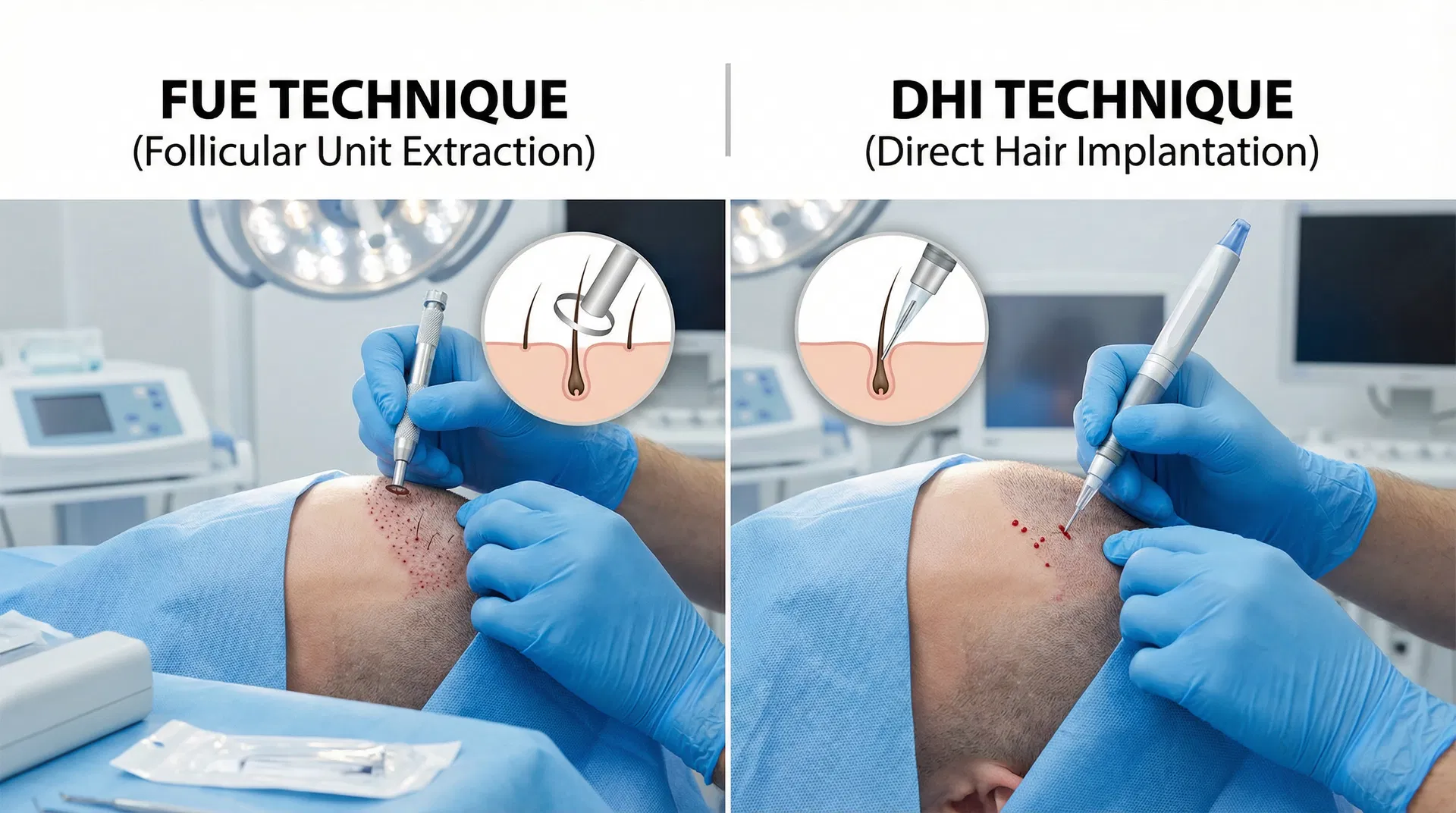
FUE
Follicular Unit Extraction
Individual follicles are extracted from the donor area using a micro-punch tool (0.6-0.8mm), then implanted into tiny channels created in the recipient area. This is the most widely performed technique worldwide.
Most common technique — proven track record
Minimal scarring — tiny dot scars invisible to the naked eye
Suitable for large sessions (3,000 to 5,000+ grafts)
Sapphire FUE uses sapphire blades for faster healing
Typically $2,500 to $7,000 CAD in Turkey
DHI
Direct Hair Implantation
Follicles are extracted and immediately implanted using a special Choi implanter pen, eliminating the need for pre-made channels. This allows for more precise control over angle, depth, and direction.
More precise angle and depth control
Higher density results in targeted areas
Shorter time outside the body (higher graft survival)
Can be done without shaving (unshaven DHI)
Typically $3,000 to $8,000 CAD in Turkey
Which should Canadian patients choose? For most patients, Sapphire FUE offers the best balance of results and value. DHI may be recommended if you need higher density in specific areas or prefer an unshaven procedure. Your surgeon will recommend the best approach based on your individual hair loss pattern. Either way, the savings compared to having the same procedure in Toronto, Vancouver, or Montreal are significant.
Step 4
The Big Day
Procedure Day: What to Expect
Morning: Arrival & Preparation
Your driver will pick you up from your hotel early in the morning — most clinics provide complimentary VIP transfers throughout your stay. At the clinic, you'll change into a gown, and the doctor will finalise your hairline design. Blood tests are performed to ensure you're fit for the procedure.
Local Anaesthesia
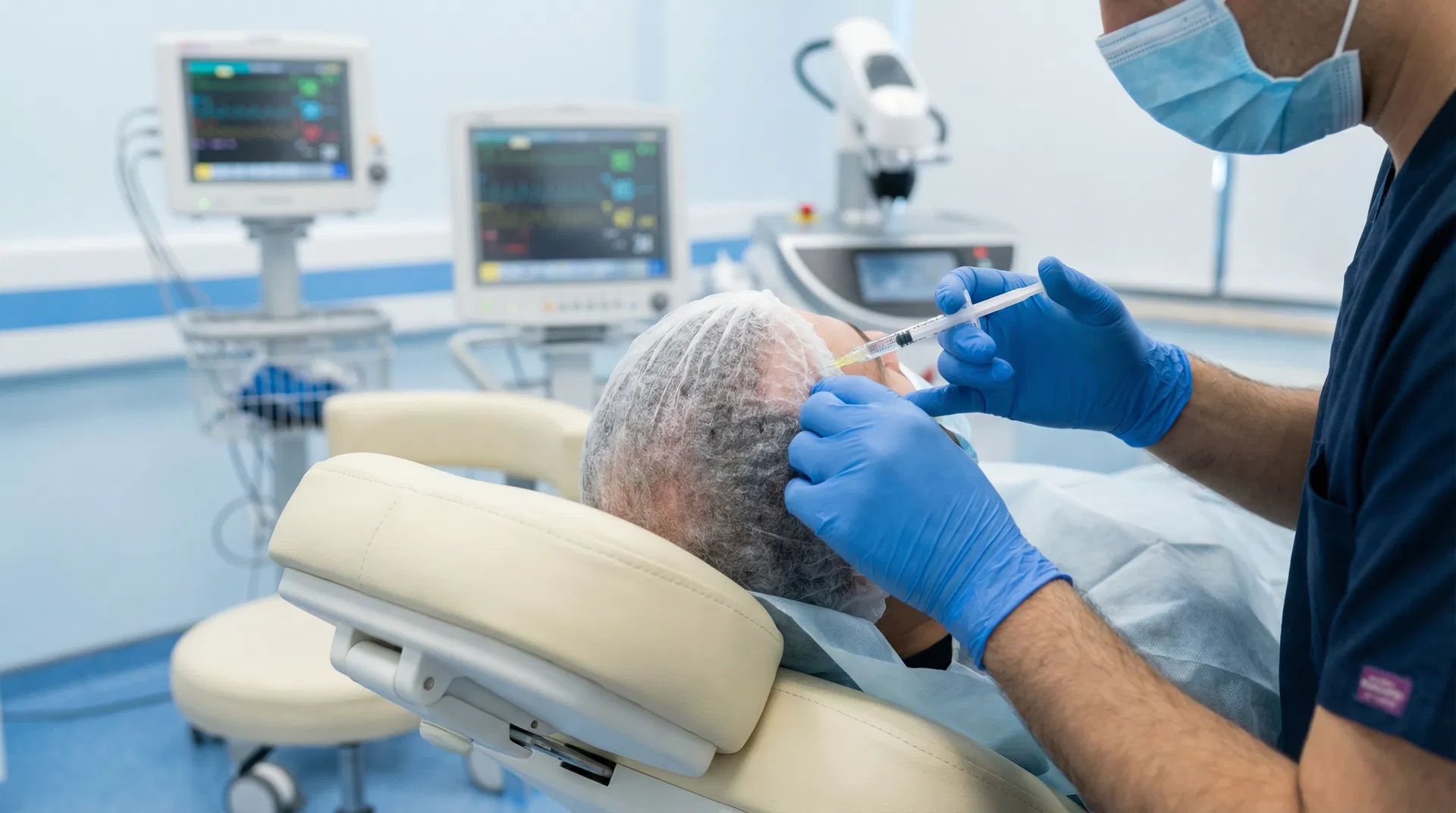
The donor and recipient areas are numbed with local anaesthesia. This is the only uncomfortable part — a brief stinging sensation that lasts a few minutes. Many top Turkish clinics now offer "needle-free" anaesthesia using a pressurised device, which significantly reduces discomfort. After numbing, you won't feel any pain for the rest of the procedure.
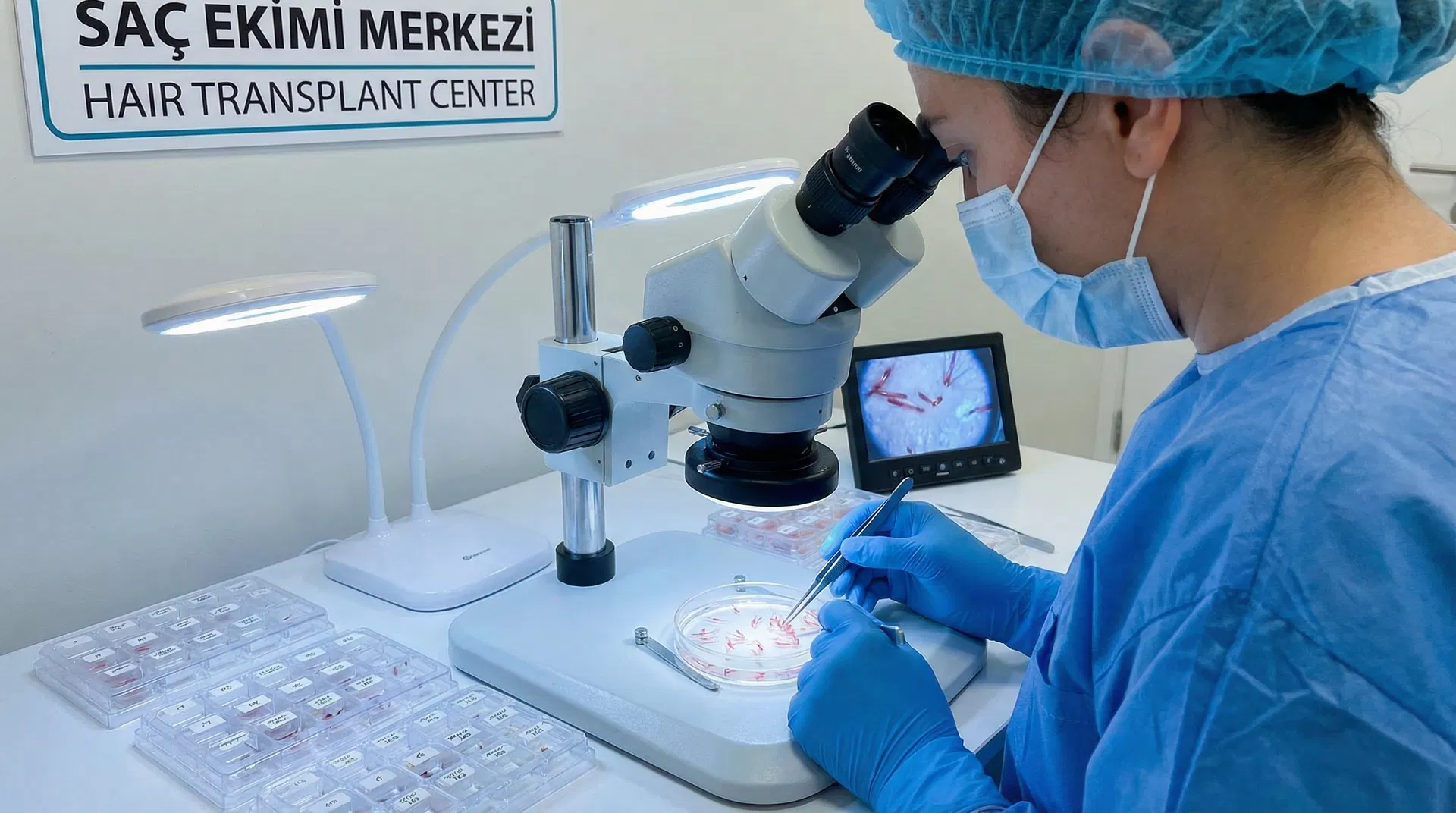
Each graft is carefully sorted and prepared under magnification
Extraction Phase (2 to 3 Hours)
Individual follicular units are carefully extracted from the donor area at the back of your head using a micro-punch tool. You'll be lying face down, and most patients watch Netflix, listen to podcasts, or even nap. The surgeon uses magnification loupes for precision — each graft contains 1 to 4 hair follicles.
The extracted grafts are placed in a special holding solution (typically Hypothermosol) to maintain viability until implantation. A dedicated technician sorts and counts the grafts under a microscope — this meticulous quality control is one of the reasons Turkish clinics achieve such high graft survival rates.
Lunch Break
Yes, you get a proper lunch break! The clinic will provide a meal — many Turkish clinics serve a generous spread of local cuisine. You can also bring your own snacks or food.
Implantation Phase (3 to 4 Hours)
The extracted grafts are carefully implanted into the recipient area following the pre-designed hairline. Each graft is placed at the correct angle and depth to mimic natural growth. Single-hair grafts are placed at the hairline for a soft, natural edge, while multi-hair grafts provide density behind it.
You'll be lying back comfortably during this phase — many patients describe it as the most relaxing part. The clinic provides entertainment options, snacks, and drinks. Some Canadian patients joke that it's the most uninterrupted screen time they've had in years.
Completion & Aftercare
The area is cleaned, bandaged, and you'll receive detailed aftercare instructions and a comprehensive aftercare kit. You'll leave the clinic the same day and return to your hotel to rest. The entire process typically takes 6 to 8 hours.
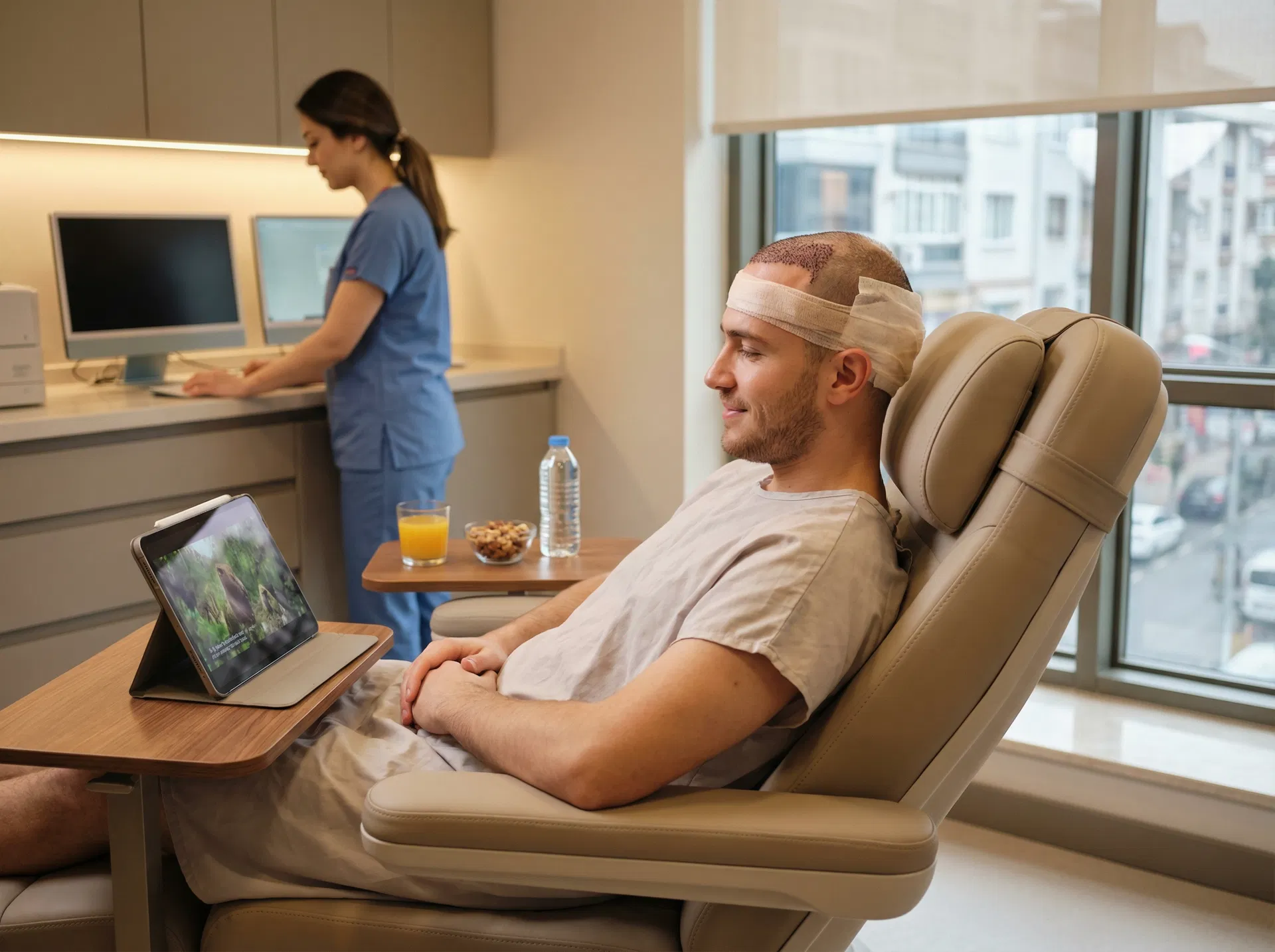
Patients relax with entertainment, snacks, and refreshments during the procedure
Step 5
Post-Procedure
Your Aftercare Kit & First Days

A typical aftercare kit provided by premium Turkish clinics
🌙
Night of Procedure
Return to your hotel with a bandage. Sleep elevated (45 degrees) using the special pillow provided. Some patients experience mild discomfort — the prescribed painkillers will help. Most describe it as a 2 or 3 out of 10 on the pain scale.
🏥
Day After (Clinic Visit)
Return to the clinic for your first check-up. The medical team removes the donor area bandage, cleans the transplanted zone, and demonstrates the proper hair washing technique you'll follow at home.
🚶
Days 2-3 in Turkey
Mild swelling may appear on the forehead — completely normal and temporary. You can do light walking and sightseeing. Many Canadian patients enjoy a gentle Bosphorus cruise or visit the Grand Bazaar during this recovery window.
✈️
Flying Home to Canada
Most hair transplant patients fly home on day 4 or 5. Wear the loose hat provided by the clinic. The flight is comfortable — just stay hydrated. Cabin pressure won't affect your grafts. You'll be back in Canada within hours.

Step 6
The Journey to Full Results
Recovery & Results Timeline
Patience is key. Here's what to expect month by month once you're back home in Canada:
Week 1-25%
Healing Phase
Scabbing forms and naturally falls off. Gentle washing with the special shampoo provided. The donor area heals quickly — most people won't notice anything. You can return to desk work within 2 to 3 days of arriving home in Canada.
Week 2-410%
Shock Loss
The transplanted hairs fall out — this is completely normal and expected. Don't panic! The follicles remain alive beneath the surface, preparing for new growth. This phase catches many Canadian patients off guard, but your clinic will reassure you via WhatsApp.
Month 2-315%
Dormant Phase
Not much visible change. The follicles are regenerating beneath the skin. This is the hardest part psychologically — stay patient. Your clinic will check in with you remotely during this period.
Month 3-540%
New Growth Begins
Fine, wispy new hairs start emerging. It may look thin at first — this is normal. The hair will thicken over time. This is when Canadian patients start to feel excited about their decision.
Month 5-870%
Visible Transformation
Noticeable growth and thickening. Friends and colleagues start commenting. You'll see a real difference compared to your pre-procedure photos. Most patients feel confident enough to stop wearing hats.
Month 8-1290%
Dramatic Results
Significant density achieved. Hair continues to mature and thicken. You'll notice a dramatic difference. Many Canadian patients schedule their 12-month follow-up photos around this time.
Month 12-18100%
Final Results
Full density achieved. The transplanted hair is permanent and will continue to grow naturally for the rest of your life. You can cut, style, colour, and treat it just like the rest of your hair. No special maintenance required.
What to Expect Back Home in Canada
Once you return to Canada, your clinic will continue to support you remotely. Most clinics offer WhatsApp follow-ups at regular intervals — typically at 1 month, 3 months, 6 months, and 12 months post-procedure. You can send photos and receive guidance from your medical team at any time.
You can return to desk work within 2 to 3 days of arriving home. Physical labour or intense exercise should wait 2 to 3 weeks. Most Canadian patients report that colleagues don't notice anything unusual — especially if you wear a hat for the first week or two.
Canadian weather consideration: If you have your procedure in winter, the cold Canadian climate won't harm your grafts, but you should protect your scalp from harsh winds and extreme cold with a loose-fitting toque. In summer, avoid direct sun exposure for at least 3 months — a hat is your best friend during recovery.
The results of a hair transplant in Turkey are permanent. Your transplanted hair will grow, and you can cut, style, and treat it just like the rest of your hair. No special maintenance is required beyond normal hair care.

The final result: natural-looking, permanent hair restoration
Common Questions from Men in Canada
Does It Hurt?
The local anaesthesia injection causes brief discomfort (a few minutes), but the procedure itself is painless. Most patients rate the overall experience as a 2 or 3 out of 10. Many Turkish clinics now offer needle-free anaesthesia for even greater comfort.
How Long Does It Take?
A typical FUE procedure takes 6 to 8 hours, including breaks. DHI may take slightly longer for the same number of grafts. You'll have a lunch break and can use your phone, watch movies, or listen to music throughout.
What Are the Risks?
Hair transplants are very safe when performed by qualified surgeons. Minor risks include temporary swelling, numbness, and infection (rare with proper aftercare). Serious complications are extremely rare at accredited clinics. Read our full risks & safety guide for details.
Will It Look Natural?
With modern FUE and DHI techniques, the results are virtually undetectable. The key is choosing an experienced surgeon who understands natural hairline design. The 'hair plug' look is a thing of the past.
Is It Covered by Provincial Health Plans?
Hair transplants are considered cosmetic and are not covered by Canadian provincial health plans (OHIP, RAMQ, MSP, AHCIP, etc.). However, the cost savings of having the procedure in Turkey versus Canada are substantial — typically 50 to 70% less.
How Many Grafts Will I Need?
This depends on your Norwood stage and goals. Typical ranges: hairline restoration (1,500-2,500 grafts), moderate coverage (2,500-3,500 grafts), extensive restoration (3,500-5,000+ grafts). Your surgeon will provide an exact estimate during consultation.
How Soon Can I Fly After?
Most Canadian patients fly home on day 3 to 5 after the procedure. The cabin pressure on the flight back to Canada won't affect your grafts. Just wear the loose hat provided by the clinic and stay hydrated during the flight.
Which City in Turkey Should I Choose?
Istanbul is the most popular destination with the highest concentration of world-class clinics. Antalya and Ankara are also excellent options. Check our city guides for detailed comparisons to help you decide.
Ready to Take the Next Step?
Thousands of Canadians have already made the journey to Turkey for a hair transplant. Our team can connect you with experienced surgeons who will answer all your questions. Free and confidential.